Primrose leaf violet, Viola primulifolia, is a native herbaceous perennial plant blooming in the spring. These violets have white flowers. This violet has long leaves that separate it from many other species of violets. Violets are common and frequently they are often not recognized as an important part of the eco-system.
Violets have two types of flowers: chasmogamous flowers which are the flowers we normally see and cleistogamous flowers which are not showy, remain closed, and self-fertilize. Here the discussion is about the chasmogamous flowers.
The violet family has a long history of taxonomic confusion and dispute and many hybrids have been found. Since violet species are frequently difficult to identify, the features that are used in a dichotomous key are presented here. These features are useful to help distinguish between the species.
Plant & Leaves
Primrose leaf violet, Viola primulifolia, plants and leaves:
Most dichotomous keys start first with whether the violet plant is stemmed or stemless.
- Stemmed (caulescent,): The plant produces a stalk with both leaves and flowers. The flowers grow from the leaf axils. Also, basal leaves may or may not be present.
- Stemless (acaulescent): The plant produces separate flower stalks and leaf stalks. The leaf and the flower stalks emerge directly from the ground (rhizomes or stolons). Leaves are all basal.
Primrose leaf violet, Viola primulifolia is stemless. Its long leaves separate it from some other species of violets. However, there are other species of violets with long leaves.
Key plant/leaf characteristics of primrose leaf violet, Viola primulifolia, are:
- plant: stemless (acaulescent), leaves & flower stalks directly from the ground (rhizomes or stolons).
- leaf blade:
- 1.5–2.5 times as long as wide
- broader at the base
- widely tapering to truncate or subcordate at the base
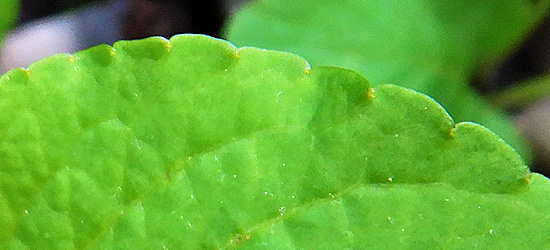
- the margins crenate (rounded shallow teeth)
- teeth with inconspicuous pale glands
The plant produces separate flower stalks and leaf stalks. The leaf and the flower stalks emerge directly from the ground. Leaves are all basal.
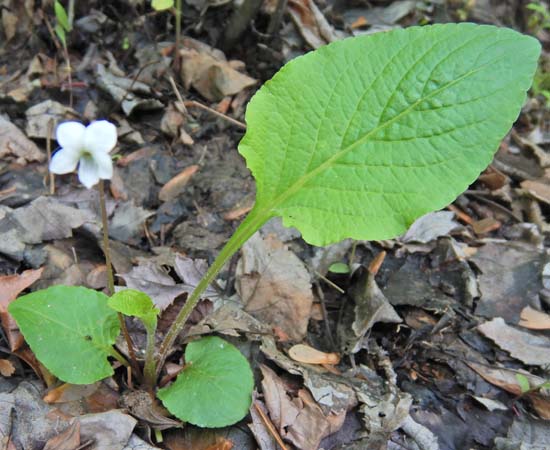
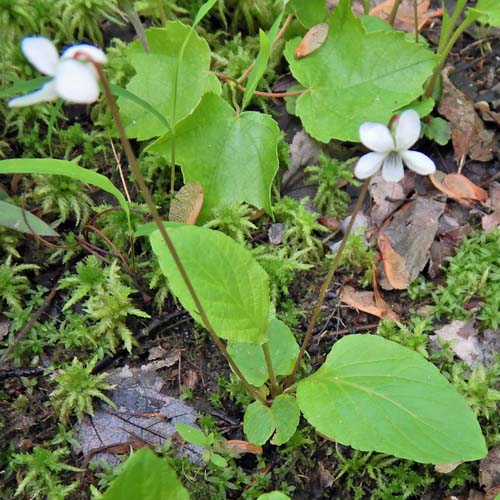
This plant develops stolons (above ground runners) by summer. The stolons are not always apparent till later in the season.
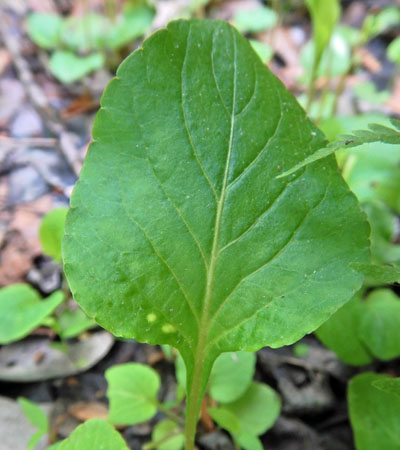
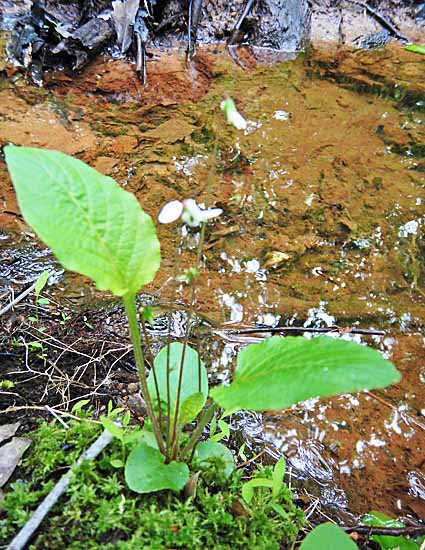
The leaves are somewhat variable. In the first photo above, the large leaf is about 1.5 times as wide and its base is almost truncate. At the bottom of the plant is a small leaf where the base is sub-chordate.
In the photos below, the left leaf is about 1.5 times as wide as it is long while the right is about 1.75 times as wide.
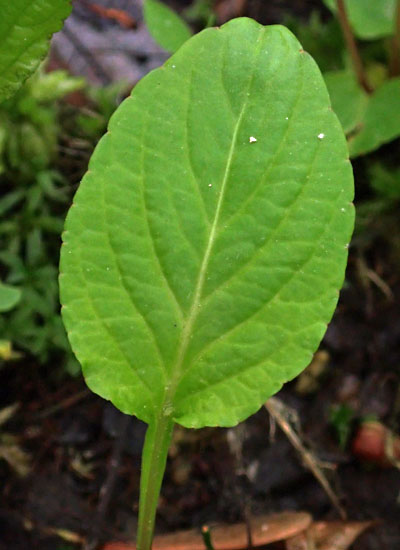
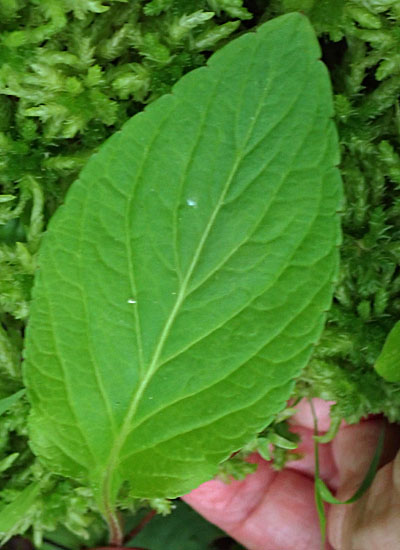
The leaf below is almost triangular with a truncate base.
All the leaf margins are crenulated. Just visible are the inconspicuous pale glands between the crenulations.
Flowers & Fruit
Primrose leaf violet, Viola primulifolia, flower & fruit:
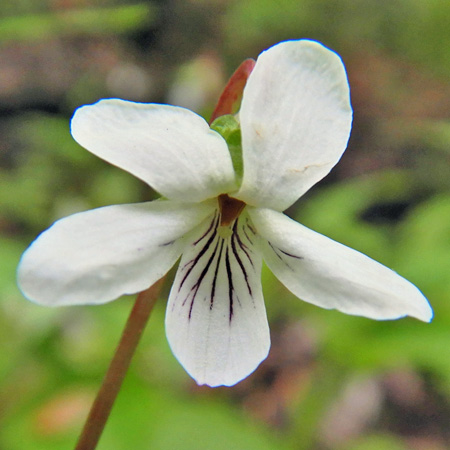
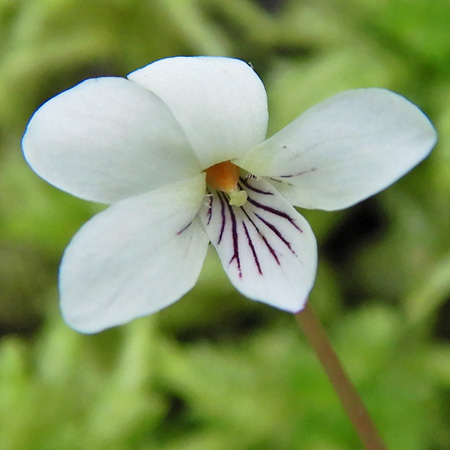
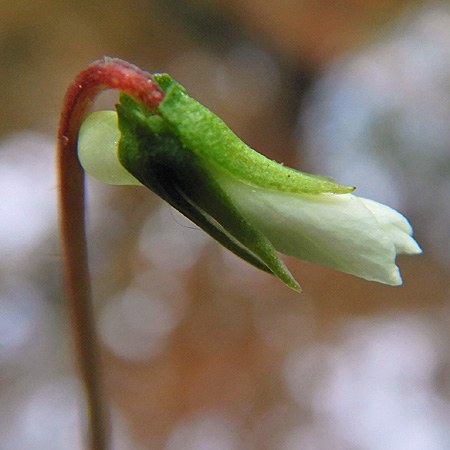
Several flower stalks can arise from the ground, each with a single flower at the top. The stalks curve downward at the top so the flower is slightly nodding. The flower has the characteristic violet shaped corolla but is white. Violets have 5 petals - 2 upper, 2 lateral, and 1 lower lip. Also, they have 5 stamens and 1 pistil and 5 sepals.
General violet flower structure
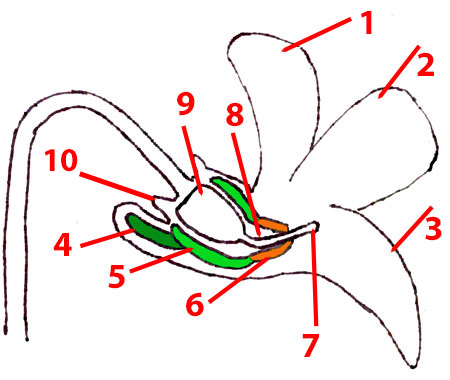
- upper petal
- lateral petal
- lower lip, back extends into a spur
- nectary structure: the lower two anthers have spur-like nectary glands on their back side and they extend into the spur of the lower petal
- anthers form a ring around the ovary
- anther appendage, brown/orange color, encircles the style; together with the anthers, a cone is formed around the ovary and part of the style; the anthers release the pollen into the interior of the cone.
- stigma, shape depends on species
- style
- ovary
- sepal with auriculate appendage at base
Key flower characteristics of primrose leaf violet, Viola primulifolia:
- white corolla
- flowers are relatively small, about a half inch or less.
- dark blue streaks, mainly on the lower petal, some on the lateral petals
- spur 1-3 mm
- stigma broad
- stigma beardless
The stigma is broad and hairless. It has a projection toward the lower petal/lip. There are short stubby hairs on the lateral petals. However, the lateral petals can also be beardless (no hairs).
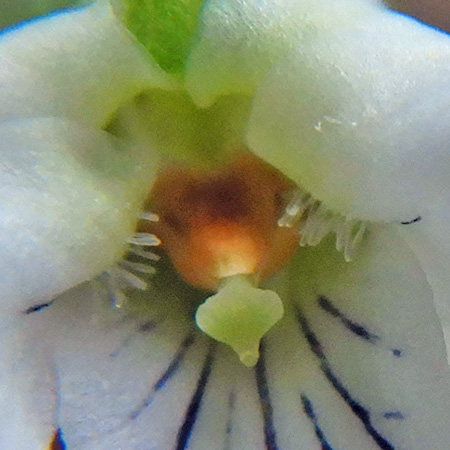
The brown/orange part is the anther appendages that with the anthers surround the ovary and part of the style. The pollen is released by the anthers into the area between the ovary and anthers (introrse - opening inward, towards the flower's center). Numbers are the same used in the diagram above.
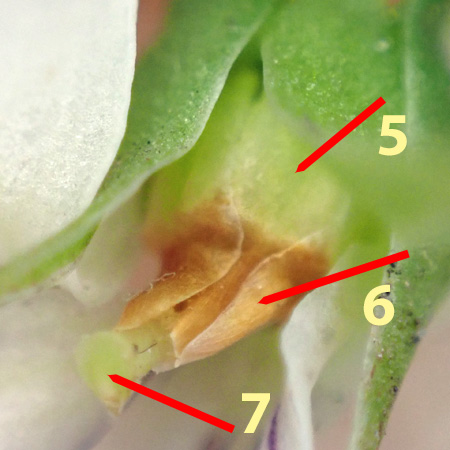
The small spur which is an extension of the lower lip contains nectar. No hairs on sepals or flower stalk.
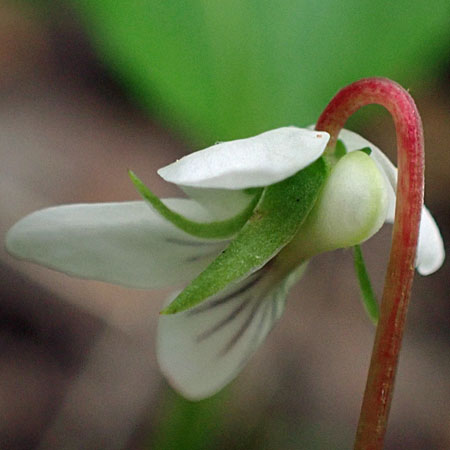
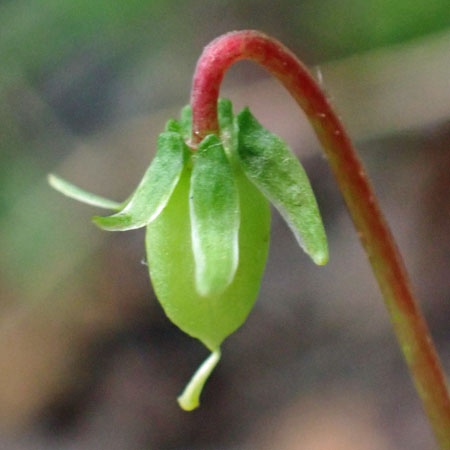
Sepals have small 'auricle/ ear-like' tabs.
The developing fruit shows clearly the sepals and the large auricle appendages.
Habitat Primrose leaf violet grows in moist and wet areas.
Habitat: note the sphagnum moss and the free water. Location: Cheesequake State Park.
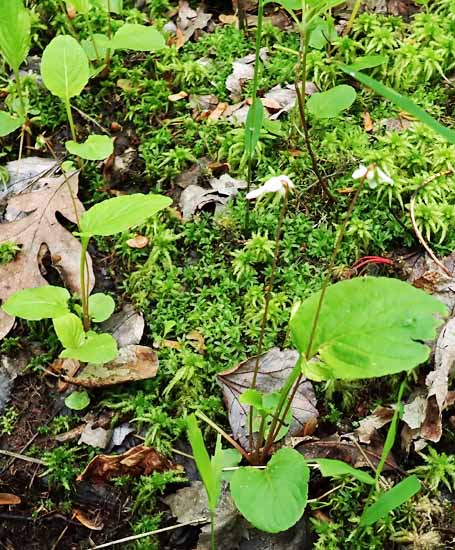
Primrose leaf violet blooms April to May.
In general, pollinators of violets include bees, ants, hover-flies, butterflies, moths and beetles. As pollinators feed on the nectar in the spur, hopefully, they disrupt the anthers and appendages to pick up pollen and/or deposit pollen from other plants on to the stigma.
Violets are an important part of the eco-system: the flower provides pollen and nectar for early insects. Violets are the host plants for fritillary butterfly species - adults lay their eggs next to or on the violets and when the caterpillars emerge, they feed on the violet leaves. Birds eat the seeds and leaves and stems are eaten by some mammals. Fortunately, deer do not prefer violets for food.
Viola primulifolia and Viola lanceolata are very similiar. Here are key differences:
- Viola primulifolia: leaf wider: 1.5–2.5 times as long as wide and leaf blade has teeth with inconspicuous pale glands.
- Viola lanceolata: leaf narrower: 3–7 times as long as wide and leaf blade has teeth with distinct red-brown to black gland.
There are two varieties of Viola primulifolia:
- Viola primulifolia var. primulifolia, Primrose Leaf Violet. This is the variety discussed on this page.
- Viola primulifolia var. occidentalis, Western White Bog Violet.
Text & diagram by Millie Ling and all photos by Hubert & Millie Ling. Photos: May 17, 2024, Cheesequake State Park, NJ.
Additional information / References
Additional information / references:
- Descriptions
- Illinois Wildflowers https://www.illinoiswildflowers.info/savanna/plants/prlv_violet.html
- Minnesota wildflower https://www.minnesotawildflowers.info/flower/primrose-leaved-violet
- GoBotany: compares to look-alike V. lanceolata https://gobotany.nativeplanttrust.org/species/viola/primulifolia/
- Flora of North America http://www.efloras.org/florataxon.aspx?flora_id=1&taxon_id=242354699
- Dichotomous Keys to Viola
- Go Botany https://gobotany.nativeplanttrust.org/dkey/viola
- Flora of the Southeastern United States (includes NJ) https://fsus.ncbg.unc.edu/show-key.php?taxonid=66052#K40066
- Flora of North America http://www.efloras.org/florataxon.aspx?flora_id=1&taxon_id=134607