Monarda punctata, eastern horsemint, is an attractive plant with layers of small flowers hidden below whorls of purplish bracts. Common names include: spotted beebalm, dotted horsemint, horsemint. It blooms in late summer. Horsemint is part of the mint family, Lamiaceae.
Flowers
Inflorescence/Flower cluster:
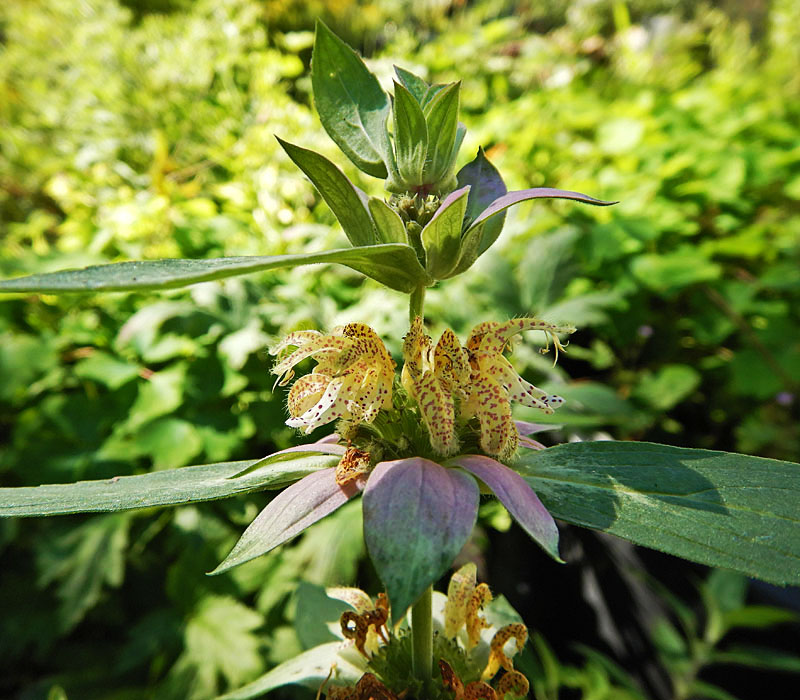
In Monarda punctata, layers of flower clusters form at the top of the stem. The cluster of crowded flowers encircle the stem. In the photo below are 3 layers, the lowest the flowers are finished, the highest the flowers are just beginning to bud, while the middle layer is in full bloom. Beneath each layer of flowers are pale purplish/pinkish bracts. Only some of the flowers of each cluster is open at one time. Behind and below the open flowers in the middle layer are flowers that are buds, partially developed, and done leaving calyxes without corollas. There are 2 to 6 layers on a flowering shoot.
Individual Flower:
The showy corolla is pale yellow with marroon spots. The tubular corolla opens up into two lips, an upper and a lower lip. The upper curved lip is narrow, keeled, hairy on the outer side and with a tuff of hairs at the tip. It arches downward over the lower lip. The wider lower lip has 3 lobes with the middle lobe bending slightly upward. The underside is also hairy. It has 2 stamens and 1 pistil.
Some details: The basic female reproductive structure is the carpel that consists of an ovary, style, and stigma. If there is only one carpel, it is called a (one)pistil. If there is more than one carpel and they are fused, the carpels together is called a (one) pistil. Horsemint has 2 fused carpels and are called one pistil. The ovaries and styles are fused but the 2 stigmas are separate.
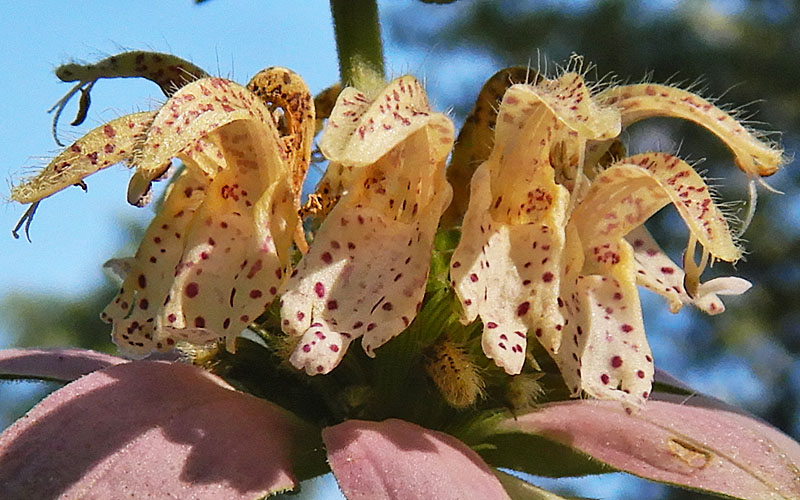
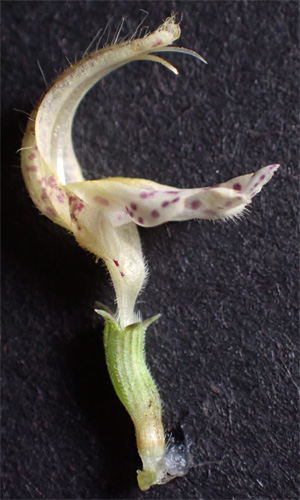
The entire flower including the green calyx is about 3/4 to 1 inch long. The corolla extends down into the calyx. The flower has one pistil and seen in the photo below. The style follows the inside curvature of upper petal and the stigma divides into two. The stamens here have fallen off.
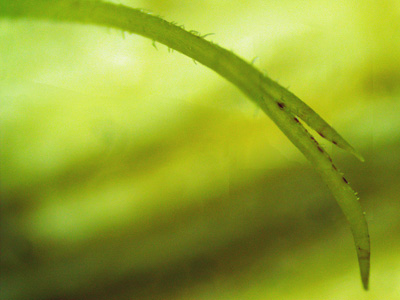
Micrograph of the style that divides into 2 unequal stigmas.
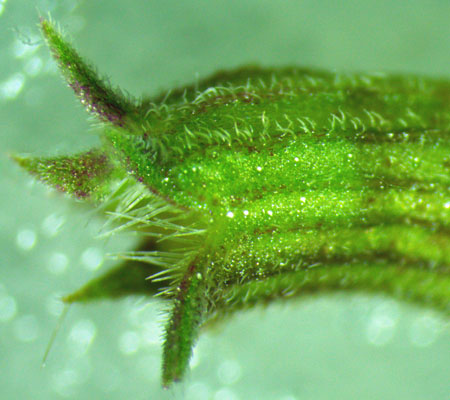
Micrograph: The green hairy tubular calyx is formed by the fusion of 5 sepals giving 5 pointed lobes.
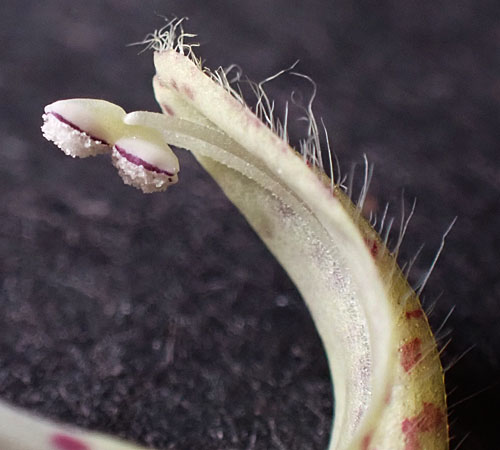
Here, just under the upper lip, only the anthers and the filaments can be seen. The filaments of the stamens like the style follow the inside curvature of upper petal. There are two stamens.
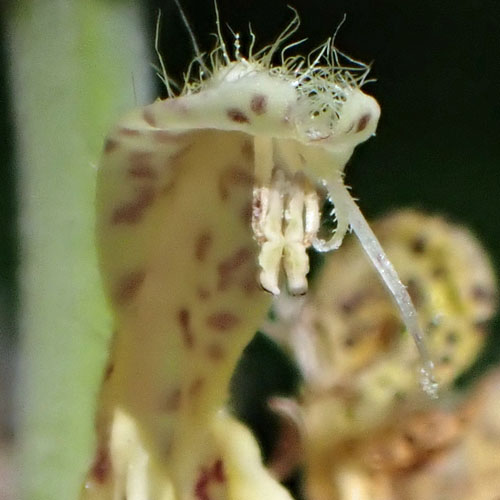
Here, just under the upper lip, in addition to the anthers, the style/stigma can be seen.
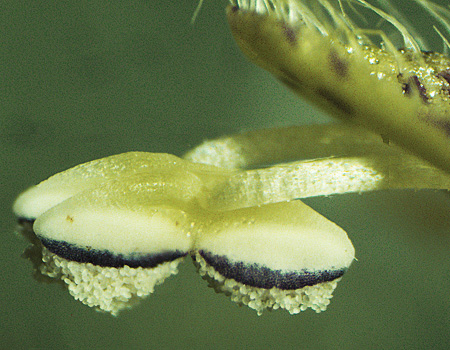
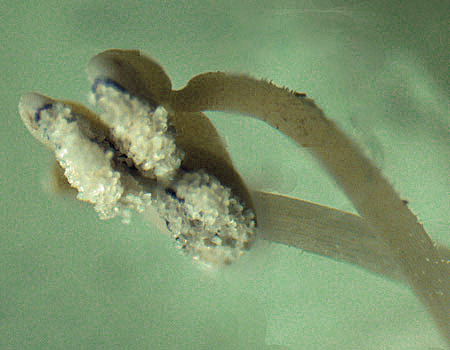
Micrographs: 2 anthers: The 2 anthers are attached together. The anthers have split (dehised) exposing their pollen.
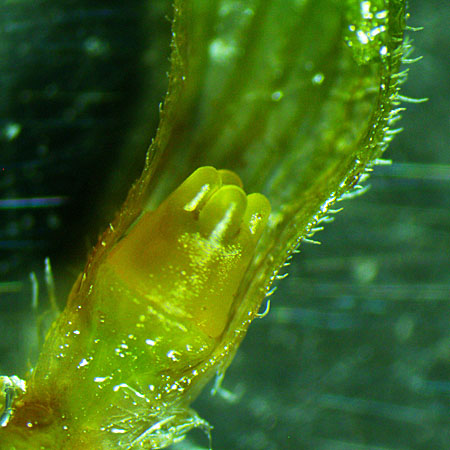
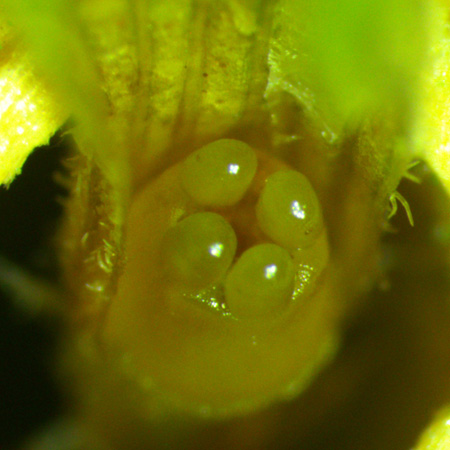
Horsemint has 2 capels with the two ovaries fused into one. However, early in development, the ovary forms into a 4 lobed ovary and is inside of the corolla tube at its base. The corolla is inside the calyx. In the micrographs below, the corolla was removed and only part of the caylx remained. The style is not connected to the top of the ovary lobes. Each ovary lobe develops into a nutlet which contains a single seed. Beneath the 4 lobes is the barrel shaped nectary disc. Below the nectary disc is the attachment point for the corolla inside the calyx.
Excelent diagram of Monarda punctata
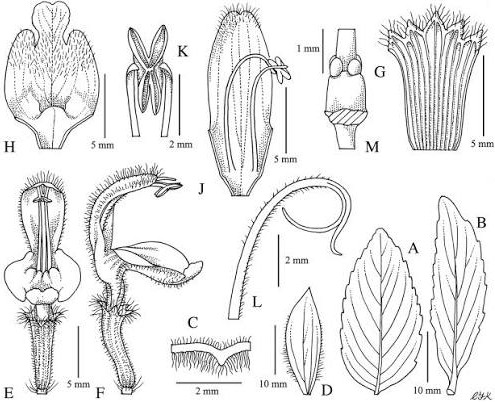

A, leaf from young shoot;
B, leaf from inflorescence;
C, t/s of leaf B;
D, leafy bract;
E, flower, face view;
F, flower, side view;
G, calyx, opened out, inner surface;
H, distal part of corolla, lower portion;
J,distal part of corolla, upper portion;
K, anthers;
L, distal part of style and stigma;
M, gynoecium with 4 developing nutlets.
Drawn by Christabel King from material growing in the North American Prairie, Royal Botanic Gardens,Wakehurst Place.
Creative Commons Attribution-NonCommercial
© 2024 The Authors. Curtis's Botanical Magazine published by John Wiley & Sons Ltd on behalf of The Board of Trustees of the Royal
Botanic Gardens, Kew.
Leaves
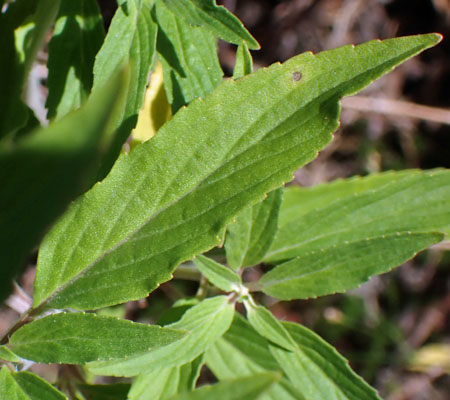
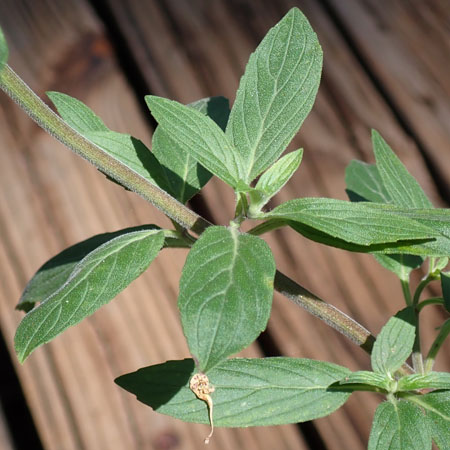
Monarda punctata, horsemint, leaves are opposite, have short stalks, and are lance-like shaped coming to a point at the tip. Leaf margins mainly have shallow teeth and surfaces have soft hairs. The blade is about 3.5 inches long and 1 inch wide. Frequently, there are small leaf growths at the axils.
Plant
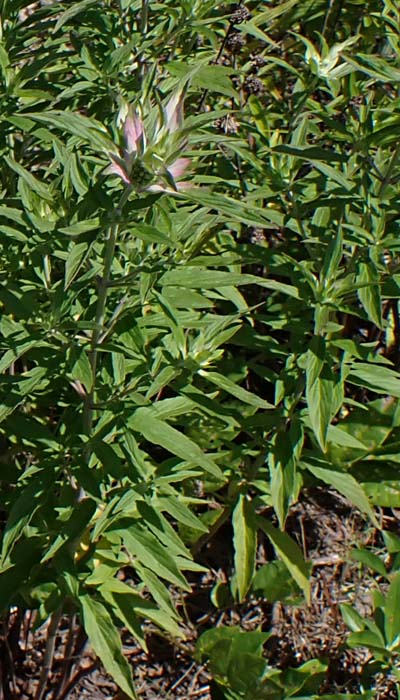
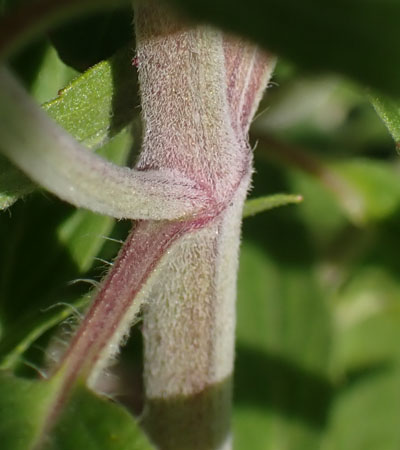
Plant: Horsemint is a short lived perennial. It is erect, growing to 3 ft. The stem is hairy and softly 4 angled.
Text by Millie Ling and all photos by Hubert & Millie Ling. Dissections and micrographs by Hubert Ling. Photos: August 15 2026 cultivation & July 24 2026 Franklin Parker Preserve, NJ.
Additional information & References
Additional information / references:
- Plants of the Eloise Butler Wildflower Garden: https://friendsofeloisebutler.org/pages/plants/spottedbeebalm.html
- Flora of Southeastern US : https://fsus.ncbg.unc.edu/main.php?pg=show-taxon.php&&plantname=monarda+punctata&limit=1&offset=3&taxonid=5371
- Illinois Wildflowers: https://www.illinoiswildflowers.info/prairie/plantx/sp_balm.htm
- Missouri Plants: https://www.missouriplants.com/Monarda_punctata_page.html
- NJ Friendly Yards - great horticulture information: https://jerseyyards.org/plant/monarda-punctata/