Asclepias tuberosa, Butterfly Milkweed is a tall native perennial herbaceous plant and like all milkweeds, it is a great source of nectar for its pollinators and other insects. Its striking orange flowers differentiates it from other milkweeds
Flowers
Inflorescence/Flower cluster:
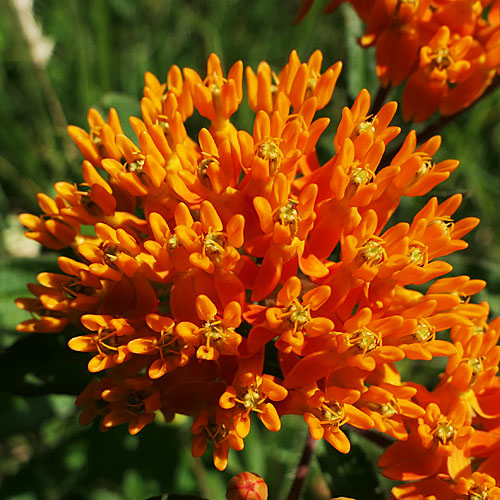
These vivid orange to orange-red flowers on top of the plant stems cannot be missed.
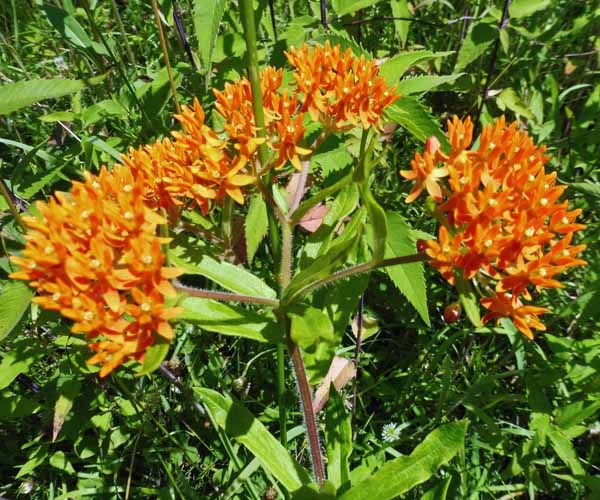
The flowers occur in clusters that are flat to slightly dome-shaped umbels (flowers spreading from a common point). These clusters develop from the upper stems and the axils of upper leaves and are 1–2½ inches across with 8-25 flowers each. The plants bloom in the summer.
Single umbels of about 8 to 25 flowers

Several clusters on one plant
Individual Flower:
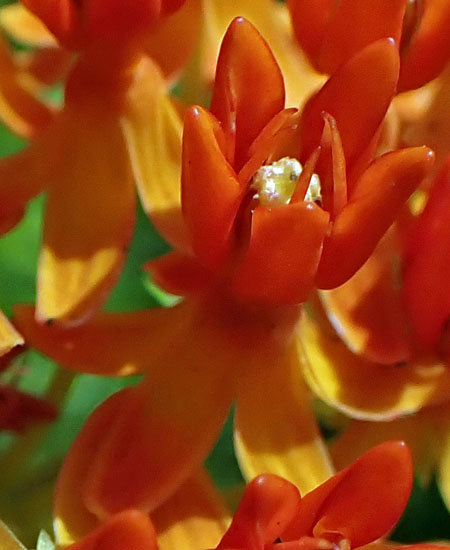
Each flower is about 3/8 inches across. The entire flower is bright yellow orange to orange to red orange. Sometimes the flower may be multi-colored.
Flower structure:
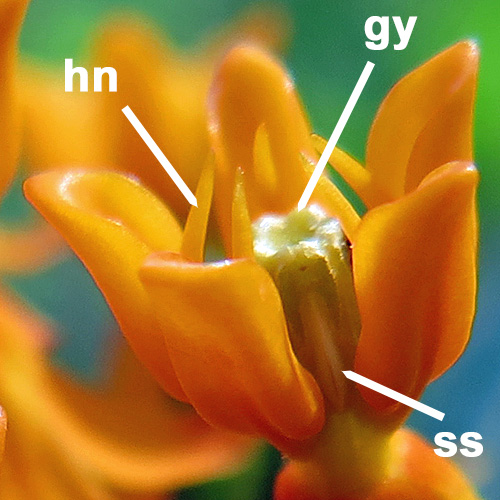
All the milkweeds have a similar structure. Labels refer to the photos below. The flower has 5 petals(pt) and 5 sepals(sp). The sepals are hard to see behing the petals.
The flower has both male and female parts and they are fused into structures that are not easily recognizable - the gynostegium (gy):
- 5 hoods(hd): It is the reservoir for the nectar.
- 5 horns(hn): At the base of the hoods and horns is a plentiful supply of nectar for pollinators and other insects.
-
Central gynostegium (gy)- reproductive parts: In the center is the fused parts of the pistil and the 5 stamens. It is columnar and flat topped.
- The center is the stigmatic chamber/s that is internally divided into 5 chambers that each contain active stigmatic surfaces. The stigmatic chambers also generate nectar that is stored in the hoods. The nectar also serves as the germination fluid for pollen grains. There are 2 ovaries, 3 of the chambers go to one ovary, and the other 2 chambers go to the second ovary.
- 5 stigmatic slits(ss). They are openings into the stigmatic chambers from the outside.
- 5 anthers which form 10 anther pouches(an) surround the outer surface of the gynostegium(gy).
- For more close up photos see - common milkweed and poke milkweed and references below.
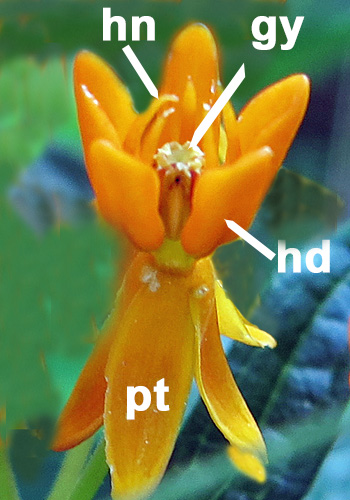
Diagram of a general milkweed flower:
- hn: horn
- cp: corpusculum
- ss: stigmatic slit
- hd: hood
- pt: petal, reflexed
- cp: corpusculum
- ta: translator arm
- ps: pollinia (pollen sac)
 Internet Archive Book Images, No restrictions, via Wikimedia Commons
Pollination:
Pollen:
- Instead of individual pollen grains, the grains are together in a pollen sac(ps) called the pollinium (pollinia - plural). See diagram above.
- The pollen sacs are paired and connected by translator arms(ta) to a dark sticky/clamp-like corpusculum(cp). These three components make up the pollen apparatus (pollinarium)
- Each anther is separated into two anther pouches(an), one on each side of a stigmatic slit(ss).
- Each anther pouch(an) contains a pollen sac/pollinium(ps).
- The way it works: A bee/pollinator comes along and while it is enjoying the nectar at the base of the hoods and horns, a leg slips into a stigmatic slit.
- When the bee tries to remove its leg out of the stigmatic slit, it hits the dark corpusculum which is sticky and sticks on to the bee's leg. While removing its leg with the corpusculum stuck to it, the two pollen sacs that are connected to corpusculum by the translator arms, get lifted out of the top of the anther pouches!
- The bee continues with the whole pollen apparatus dangling from its leg and goes to another milkweed plant
- Amazingly, when the bee lands on another milkweed plant, the pollen sac can be angled so that it goes into the stigmatic slit. Then the stigmatic surface inside the gynostegium chamber get pollinated!
- It is a complicated and amazing way to get a flower pollinated but it works well enough to keep the species alive. It is not always so straight forward. Lots can and do go wrong. Read more about this amazing process in the references below.
Plant - Leaves - Habitat
The Butterfly milkweed plant is a large upright perennial growing to 3 feet tall often branched at the top. Unlike other milkweeds, its sap is clear but it is still toxic. Don't get it in your eyes!
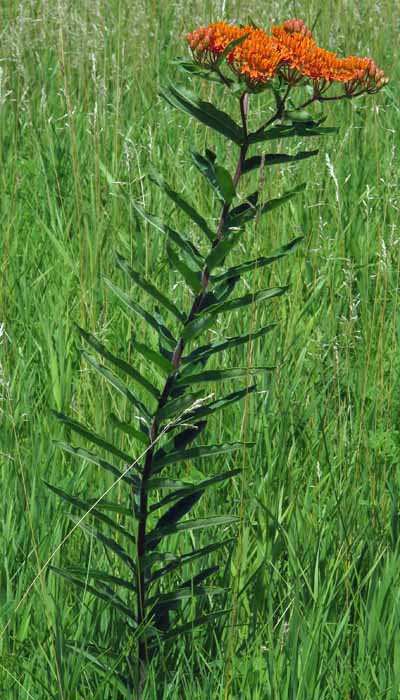
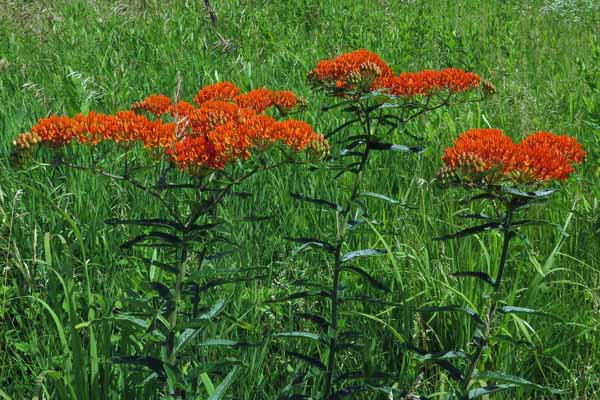
The leaves are simple and mostly alternate. The leaves are narrow - up to 6 inches long and 1 inches wide and somewhat crowded on the stem. The upper surface is glossy and the margins are smooth. The leaf shape is linear-oblong with the base slightly cordate or truncate
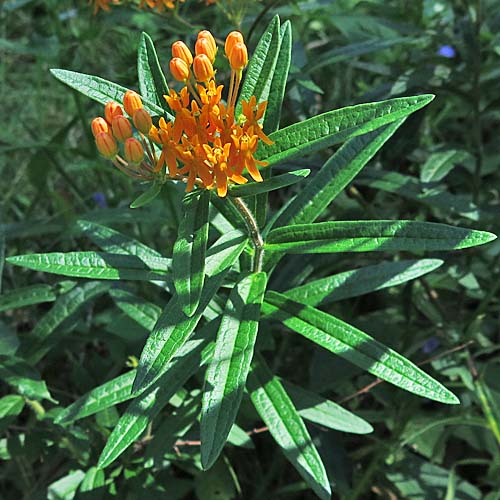
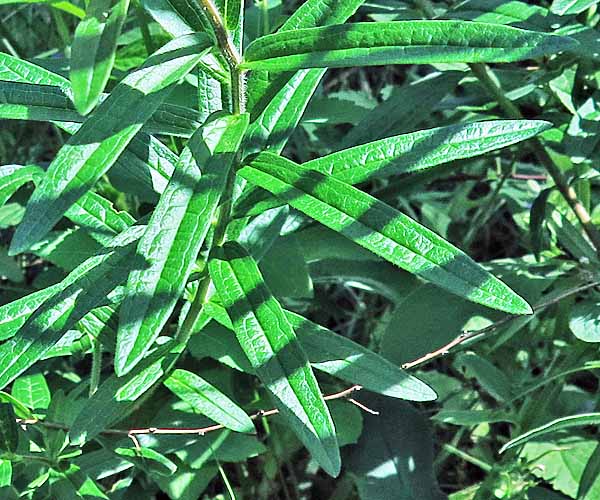
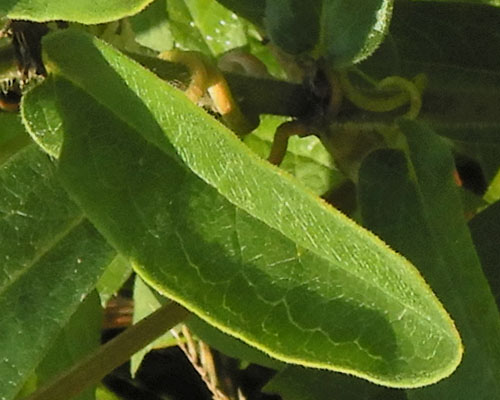
Habitat: Butterfly weed grows commonly in dry open habitats, meadows, fields and open woods.
Text by Millie Ling and all photos by Hubert & Millie Ling. Photos: Flowers - Summer: Somerset and Hunterdon County, Kittatinny Valley State Park
Additional information
Additional information / references:
- Minnesota Wildflowers
https://www.minnesotawildflowers.info/flower/butterfly-weed - Illinois Wildflowers
https://www.illinoiswildflowers.info/prairie/plantx/btf_milkweedx.htm - The Intricate Dance of Milkweed Pollination: excellent description of pollination
https://www.hachettebookgroup.com/articles/the-intricate-dance-of-milkweed-pollination/ - USDA Milkweed Pollination Biology: excellent description of pollination
https://www.nrcs.usda.gov/plantmaterials/nvpmctn12764.pdf - Key to NJ Milkweeds, New England has almost the same milkweeds as NJ: GoBotany. https://gobotany.nativeplanttrust.org/dkey/asclepias/#all